Description
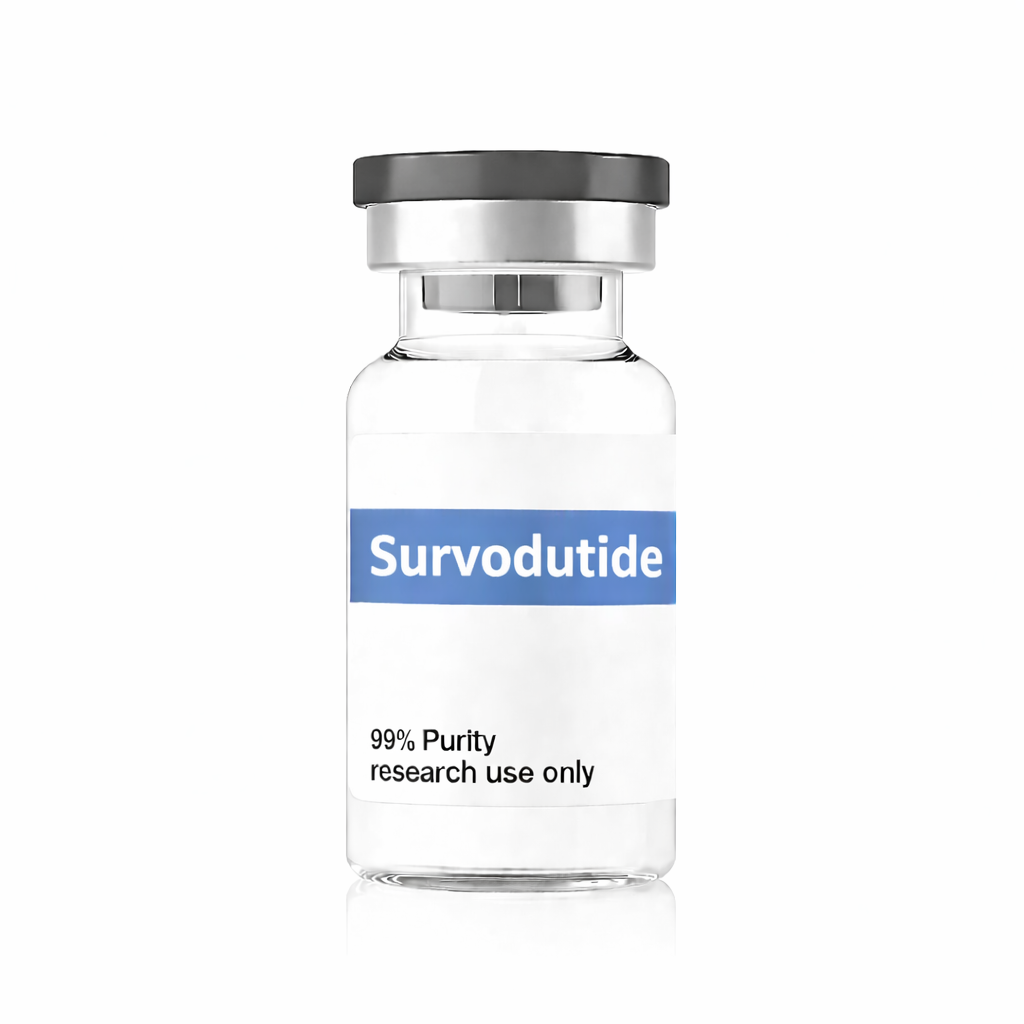
Survodutide: A New Era of Dual GLP-1/Glucagon Agonist Therapy
Survodutide (BI 456906) is rapidly emerging as a frontrunner in the next generation of anti-obesity medications. Unlike traditional GLP-1 agonists (such as semaglutide) that focus solely on appetite suppression, Survodutide introduces a dual-action mechanism that targets both the GLP-1 and glucagon receptors in the body .
Currently in Phase 3 clinical trials, this molecule is being developed by Boehringer Ingelheim to address two massive health crises: obesity and Metabolic Dysfunction-Associated Steatohepatitis (MASH) . Here is the latest clinical data, mechanism of action, and approval timeline for 2026.
What Makes Survodutide Different? The “Dual Agonist” Effect
To understand Survodutide, you must first understand the “Dual Agonist” mechanism. Most weight loss drugs (like Wegovy) are selective GLP-1 receptor agonists. Survodutide is a balanced dualagonist, meaning it activates two separate receptors simultaneously .
-
GLP-1 Receptor Agonism: This reduces appetite, increases satiety (fullness), and slows gastric emptying. This is the standard mechanism.
-
Glucagon Receptor (GCGR) Agonism: This is the “secret sauce.” Activating glucagon increases energy expenditure. Essentially, it helps the body burn more calories, addressing the metabolic slowdown often associated with dieting .
The Brain Connection:
Recent 2026 studies published in ScienceDirect reveal that Survodutide accesses the brain’s circumventricular organs (CVOs) to activate satiety nuclei without uniformly crossing the blood-brain barrier. This targeted access helps suppress food intake while utilizing glucagon to increase energy burning .
Clinical Efficacy: Weight Loss and MASH Resolution
The enthusiasm surrounding this keyword is driven by robust Phase 2 data. Survodutide has demonstrated superiority over placebo and, in specific metrics, historical benchmarks of existing GLP-1s .
1. For Weight Loss (Obesity)
In a Phase 2 trial (NCT04667377) involving 387 adults, Survodutide produced dose-dependent weight loss of up to 18.7% from baseline after 46 weeks .
-
High Responders: Up to 40% of participants achieved a ≥20% body weight reduction.
-
Cardiovascular Markers: Beyond the scale, Survodutide showed significant improvements in cardiometabolic health, reducing systolic blood pressure by up to 8.6 mm Hg and improving biomarkers like leptin and CRP (inflammation) .
2. For MASH (Liver Disease)
Survodutide has received FDA Breakthrough Therapy Designation for MASH with fibrosis .
-
In Phase 2, up to 83% of adults treated with Survodutide achieved a statistically significant improvement in MASH resolution without worsening liver fibrosis .
-
It also demonstrated high rates of liver fat content (LFC) reduction, with up to 87% of patients achieving a clinically meaningful reduction .
2026 Pipeline Status: When Will It Be Approved?
As of April 2026, Survodutide is not yet FDA approved. It is currently in the final stages of the SYNCHRONIZE Phase 3 trial program .
-
Phase 3 Trials: SYNCHRONIZE-1 (non-T2D) and SYNCHRONIZE-2 (T2D) are ongoing.
-
Expected Results: The last participant visits are expected in mid-2026, with analyzed data likely in late 2026.
-
Potential Launch: If data is positive, an FDA submission could occur in 2027, with market availability projected around 2028 .
Safety Profile and Tolerability
Because it activates the GCGR (glucagon) receptor—which is associated with increased heart rate and energy expenditure—the safety profile is closely watched.
-
Common Side Effects: Similar to other GLP-1s, the most common adverse events are gastrointestinal (nausea, diarrhea, vomiting). A meta-analysis confirmed that Survodutide is associated with a higher risk of diarrhea compared to placebo .
-
Dosing Strategy: Experts suggest that discontinuation due to adverse events in trials was often caused by rapid dose escalation; slower titration is expected to improve tolerability .
Frequently Asked Questions (FAQ)
Q: Is Survodutide stronger than Semaglutide (Wegovy)?
A: Potentially, yes. By adding glucagon agonism, Survodutide not only reduces calorie intake but also increases energy expenditure. Preclinical data suggests it may result in greater body weight reductions compared to selective GLP-1 agonists .
Q: Can I buy Survodutide right now?
A: No. Survodutide is an investigational drug. It is currently only available to participants enrolled in ongoing Phase 3 clinical trials (SYNCHRONIZE and LIVERAGE) .
Q: Does Survodutide work for type 2 diabetes?
A: While the primary focus of the current Phase 3 trials is obesity and MASH, the glucagon mechanism does impact glucose homeostasis. Data indicates survodutide reduces HbA1c, making it a promising candidate for patients with obesity and T2D .
Q: What is the difference between Tirzepatide (Zepbound) and Survodutide?
A: Tirzepatide targets GLP-1 and GIP (Glucose-dependent Insulinotropic Polypeptide). Survodutide targets GLP-1 and Glucagon. Glucagon is unique for its direct effect on increasing energy expenditure and liver fat reduction .
Conclusion
Survodutide represents a significant evolution in pharmacotherapy. While we await the critical Phase 3 data in late 2026, the existing evidence suggests it will be a dominant player in both the obesity and MASH markets due to its dual mechanism of appetite suppression and energy burning.
Reviews
There are no reviews yet.